Friday, September 26, 2014

Personal Note Dump + Notes on the Notes

Oh I guess I should make at least one more post for the year, so I decided to share my notes in the hope it inspires others to create stories and characters they've always wanted to make, but have no idea how to pull it off or where to even start. ( like me )

I started this blog because resources about storytelling AND comics seemed to be a rarity. True, a good story ( i.e. a story told in a good way, not necessarily of good quality ) should be easy to adapt no matter what the medium is, but in my honest opinion comics are Column B with a bit of Column A and a bit of Column C. A being novels/short stories and C being movies/TV shows.

It shares traits from both of those mediums. However executing it is give or take. Too much of one thing in a comic can ruin it. Whether it be exposition, back stories, introducing characters, or two-page spreads. The same goes for too little. Historically comics are short. 16, 22, 24, or 32 pages an issue or chapter. There's a lot of room, yet at the same time not enough. The idea of going into a project without a plan in place is ludicrous.

One doesn't go on a trip to someplace they've never been to by simply hopping in the car and taking off. They need a route, a map, GPS... they need a cheat sheet. So this past year I've been retooling all my cheat sheets to help me on the route to making the comics I always wanted too. Unfortunately it was all on the writing side, not the drawing side ( sigh )

So while I'm getting my drawing in order here's the writing guides I created.

Characters and Personalities


I posted this before, but this is the beefed up version. It includes not only the 5 Basic Personalities, but their opposites which are also Personalities. I also added in suggested roles for Protagonists, Antagonists, and Side-characters. With handy chart I can draw a character, list their personality from this chart, and use this chart when writing their dialogue and actions.

It keeps them all in one place, and this hardly covers the wide range of characters one can create. But for what I'm working on it's more than enough.

Composition


After doing some Page-a-Day exercises I wanted to find an easier way to construct not only comic book panels, but the pages themselves. This was simply a list of composition resources I found, copied, and put together so I have it on hand. Because I'm old and remembering stuff is hard.

How I use it is also fun. Say I'm starting with a blank page. I just simply compose a composition from the list, usually the Golden Ratio, on the entire page. Then go from there. I use the spiral to help direct word balloons and the division to create panels. No matter which is chosen, they all work. Even if you're art is shit, if the composition is fundamentally there the page will be ascetically pleasing.

Good composition along with good inking techniques and color theory can make up for shitty anatomy-- trust me, I follow comics that look like they were drawn by a kid, but look composed, inked, and colored by master. And of course good writing solves all those artistic mistakes anyways.

Joseph Campbell's Monomyth


This is basically a rip off the wikipedia article on the subject, but I don't have a computer at my drawing table. So I copied it and have it there to come up with story ideas. I also kicked myself in the head for putting off reading about the Monomyth until just last June. Afterwards I realized all my favorite stories followed this formula to the letter.

The Last Star Figher, Clash of the Titans ( the 80s one ), and of course Star Wars. In fact when one studies this in detail it's pretty obvious how much Star Wars' story was based off of this. Made me think Lucas actually is a shitty writer, but hey, he's a fucking a billionare and I'm a Level 30 Wizard of a NEET with not much of future except this throat pain I suddenly got. ( PLEASE BE CANCER )

Master Story Structure


This is like the old 22 page structure I posted earlier, and the original 24 page structure. Only those had the Acts divided equally. For some reason I decided to off-set the page ratio on the Acts. Each issue or One-shot still needs at least 3 Acts. In this version Act 1 and Act 2 are reduced for one important reason. Act 3 is what's selling the story. It needs the extra page.

I got the idea after reading some old Deathlok comics I had-- to my surprise McDuffy was one of the writers, no surprise that shit was good. It was one of my favorite titles until it was no longer on the rack. I broke those comics into scenes, along with some other C-list comics from that era-- they had this kind of structure. Short intros, medium size middles, and huge endings.

I didn't know how important it was until I wrote a comic that was 80% exposition and 20% stuff happens. Key to a good story is to have stuff happen. Escalate the risks, give the reader a huge payoff. For heavens sake don't rush the Climax, that's why people are reading it in the first place.

Sitcom Story Structure


This was an after thought because not all comics are action, yet they share the same structure. This one is focused on more real life situations, challenges, and things people can relate too with the added bonus of humor. I got the idea from watching old sitcoms. Mainly Boy Meets World and Married With Children. Two different shows, yet they both share the basic 3 act formula.

It was also easy to make since Comic Books are traditional 22 pages in the west and Sitcoms are 22 minutes long. Breaking down the scenes was cinch, a minute of a TV show equals one comic book page. 

I was going to make something with this, but I forgot what is was. Oh yeah, it was going to be a SJW parody... I ain't touching that shit after the stories I heard.

Erotic Story Structure


I'll admit, I love my porn comics. And yes, they all follow a simple structure. It's like the Sitcom Structure, only it has the wonderful addition of porn. I like the ones that tell a little story that incorporate the sex into it. Those are far more clever then seeing the two characters on the Splash Page and then they go through motions.

I don't think people can fap to my artwork even though I draw porn to get better at drawing, but who knows. Maybe I'll use this, maybe I won't, or perhaps one of you will. And if you do please send me a link so I can *ahem* take it for a ride.

Work in Progress, 16 page structure


This is the one I'm currently working on. I've got all these structures for complex stories, but I wanted to do something simple. The idea came from two sources. 1) Looney Toons and 2) the concept of making a 16 page comic in one day.

I know it sounds challenging, but I took the idea seriously. The thing is if one does a story like a Looney Toon short it could be possible. I'm not talking about the art, but the story. Those stories were simple with simple characters. Going over my notes I came to the conclusion that this is the simplist story one can make because it uses all the shortcuts that are availible and does them well. So I'll go over what I've compiled so far.

Characters

There's always at least 2 characters. A Protagonist and Antagonist and they're either rivals or driven by their own personal goals which is limited to one apiece. For instance in the Roadrunner cartoons the Coyote just wants to eat the RR, the RR just wants to run roads. That's it. The rest of the story is created from that simple premise and the scenes are all set-pieces. That doesn't mean they can't be creative. Most of those old Coyote and Roadrunner cartoons had callback jokes to the first gag.

Popeye and Bluto are rivals for Olive. Tom and Jerry, Tom wants to catch Jerry and Jerry wants food. Foghorn Leghorn is more nuetral, basically him and the dog just compete for farm supremacy, but Foghorn becomes the Antagonist with Pursy and the Chicken Hawk episodes. A rule of thumb, the Antagonist is the one who gets their shit pushed in.

Scenes, Set-Pieces, and Gags

These are based off the characters and setting a writer wants to go with. Like a construction zone. It was a popular storyline Bugs encountered where his home was threatened by development. The setting plays a huge role and can be varied by certain jobs, areas, and other pieces of public domain fiction ( Robin Hood episodes, Grimm Tales, etc ) The idea is to keep it simple, and this is as simple as one can get.

If the idea is stuck in one setting, have a 3rd party introduced. Back to Coyote and Roadrunner, the Coyote can't just fall off the cliff or run into cactus's all the time. Here comes the ACME catalog, now they got enough material to run the premise into the ground.

Same goes for Foghorn, how many gags can just him and the dog do alone?-- here's Pursy who wants a man and the Chicken Hawk who eats chickens. Both of them are tools Foghorn and the Dog both use against each other.

Working Backwards

This is the key to writing these stories fast. Say I got 2 characters, now I choose a setting. Maybe I hit up a generator to see if anything comes to mind. It should be the first one I can think of a gag for. When that happens that's going to be my Climax gag. Now I'll need to write 3 or 4 more scenes building up to that final Climax, but when I do that I might make a bigger gag than my original one. That new one is now the Climax.

The key to making these entertaining is to escalate the gags. The final Climax should be the biggest most ridiculous. The first gag should be the most mundane of the bunch. It builds up tension, it makes the reader turn the page, it makes it exciting.

How do I know a setting or story isn't good? If I can't come up with 3 or 4 more gags it's a dead end. Save it for later and try another setting, maybe different characters.The one I'll pick is the one that gives me all the gags I need to write a story. This is the best way to get use to creating stories by starting with the simpliest of them all.

And on side note I always end up a gag or two short-- but still, brainstorming is writing. It isn't writers block or procrastination. I'm on the side that believes those are excuses people use when they won't admit their shortcomings. Oh boy, do I have shortcomings. Trust me, I'm the first person to say I suck and I'm not ashamed of that. I'm my worst critic.

In Practice

After doing this I found myself using the same method for my other structures. Think of a setting and a climax then work backwards, if I can build up scenes that escalate to the climax then I got a story. If I can't, it's not a good idea and I quickly move on to another climax. Sometimes our initial intentions aren't that good. We got to let them go and explore other ideas quickly and consistently.

Of course it's possible to stretch out some scenes and make those initial ideas work, but I hate it when movies and TV shows do it. And I really hate it when comics do it. The idea behind doing really simple stories is to get comfortable writing a bunch of simple stories before moving on to more complex ones. Just like an artist has to get comfortable with basic shapes and gestures before tackling all the realistic detail.

So that's about it, probably my last post of the year unless I do flesh out that structure. In the mean time I got loads of drawing ahead of me along with a new Age Height Chart I'm making to accommodate the way my style as been evolving.

But hey, like I mentioned before on this blog we are in the new Golden Age of comics. Or at least we should be. And if what I collected and jotted down can help others then that's good enough for me. This truly is the best time to be a comic book creator with the internet, Partreon, and printing prices dropping.

It just takes time, knowledge, and passion. The key to all of this is passion.

Sunday, February 9, 2014

Comic Strip Structure

I took a break from writing comic book stories to tackle comic strips again. Since I'm anal about how things are done and love reading instructions I made myself some.

This isn't really a guaranteed way to make a comic strip, get syndicated, and swim in money-- but it is a way to get the ball rolling, write a ton of strips, and see what works and what doesn't. Unless you want to sit and stare at the wall trying to come up with a joke ( I done that, it leads me to get nothing done )

In the end it all comes down to picking a Topical Punchline, then setting up the 1st panel and seeing where it goes from there. Also wrote down ideas for characters and settings by observing ones that are used today. Only makes sense that if you want to make comic books or comic strips one should read comic books and comic strips.


Wednesday, November 27, 2013

The Solo Story Structure and DC's Digital Comic Layout

It's been over a year since I last posted ( truthfully I mostly hang out on other social media sites and forums either lurking, trolling, or participating in active conversations ) but I promised myself I wouldn't post anything here until I had a comic done.

Oh well, screw that. Because after writing solid scripts with shallow characters and shallow scripts with solid characters for the past year I came up with a Story Structure that ended up becoming the base I was looking for the past 4 years.

It sounds like a waste of time, but in the end I'm amazed how much my Story Structures have evolved ever since I started making them well before this blog was started. And to me they're important since I'm anal has hell. As I mentioned before, they're not set in stone or to be followed to the letter-- they're there to help guide me, and hopefully you as well, when writing a story so every scene and page is properly planned before any drawing process is started.

So without further ado here it is...

I got the idea for this structure from two sources. As always How to Write a Book Now is my go to place for writing techniques. For this one I was inspired by the W-Plot method which I used earlier this year to make 4 and 8 page story structures for Ashcan comics. 

The second source was from DC's Digital line-up of comics. I got into them this summer and I felt something I haven't felt since 1989 when my middle-school self first read Teenage Mutant Ninja Turtles and knew what I wanted to do with my life-- but more on DC later, lets me explain this Solo Structure and why it's different from the 2-Story, 3-Story, and 4-Story Structures.

Goal of the Solo Story Structure

It's pretty simple, it's purpose is to tell a one-shot story that is all about the Protagonist and the setting they're in. No room for separate adventures for other characters or cuts to the Antagonist-- although rules are meant to be broken, but for starters this Structure is to introduce the Protagonist and Setting to the reader without going into too much detail.

That was the major flaw in my other structures. They weren't that great for a One-Shot or a first issue mentality. With multiple situations taking place I oversold every story I made when using those structures. They became 60% explaining things and 40% things happening. In other words they sucked-- but only as One-Shots and first issues. Those Structures do work, but only as long as the writer has multiple established characters. Since those structures were based off Bronze-Age X-Men and G.I. Joe that makes sense, what I failed to realize is doing that off the bat is a bad idea.

Hell even G.I. Joe didn't go into multiple story lines until after it's first year, before then they were all self-contained stories with a small base of Joes who stuck together. It didn't branch out until more characters were established. And X-Men didn't explode to multiple stories until Giant Size changed everything.

Throwing multiple characters all at once and in a One-Shot can confuse the reader. It even confused me when I wrote them. I wrote a One-Shot 3 months ago that was a pretty solid story using the 2-Story Structure. However after I revised it I discovered my Protagonist was a side-character. Actually the Protagonist didn't do much at all. That told me I had to create a Structure that allowed me to focus on one character at a time, hence the next section...

The Protagonist gets the Spotlight

This was the real reason for making this Structure. With a simple W-Plot I'm able to focus on my Protagonist and the Setting with just enough to make an action packed story. Since I came up with this 2 and a half months ago I've written about 8 separate plot-first scripts, with one of them making it to the Thumbnail process ( which I decided to not do because I realized how boring part of the content was, not enough speed-lines in the universe can make that exciting ). And all of them had at least 3 drafts.

I found this structure perfect for a guy like me who can only handle so much at one time, although it's not perfect/perfect. After writing all those scripts I accidentally did something that made me realize this could be the go to structure for most of my future stories. It also made me think I need to revise my other structures as well, so lets dive in...

Dissecting Each Scene

To make it easier I'll post the image again with a description of each scene.

Act I

Act I is the Introduction and Catalyst. Like the other structures they're laid out with pagination in mind incase anyone wants to make a print comic. That is why it's 24 pages total and scenes 3 and 5 bleed into Acts II and III. But for digital who gives a flying fuck, that is where one can break the rules of pagination.

During Act I the protagonist is introduced, has a problem, then has a moment/solution/cool down scene to reflect on what happened in scene 2. This is the Act where one would want to insert any plot devices such as Chekov's Gun ( foreshadowing ), Option Exhausted, Red Herrings to disguise the Chekhov's Gun, or Ticking Clock.

Already I bet you're coming up with ideas, I know I did. Scene 1 would show a city, cut to a bank, there are hostages. Scene 2 the protagonist comes in, tries to stop the antagonist, doesn't-- but saves the hostages, only to discover it was a ploy to get the protagonist's attention. The real threat is a bomb in the city and a Ticking Clock has started.

See how fun writing can be!!

Act II

Act II was the most tricky of the 3 Acts, mostly because this is where the writer can fall prey to Sagging Middles. The W-Plot intrigued me because of the 2nd Triggering Event or simply the Event. ( something I plan to add to my other structures at some point, hey they're over a year old, of course they're outdated )

The Event can be anything the writer can think of to accelerate the story. It can be a flashback, cut to the antagonist ( whoops broke my rules again ), fanservice, a sex scene, or simply a moment that changes the protagonist's line of thinking to get them to the next scene and get closer to their goal.

The Event is there to keep the story moving, and for comics that's pretty important. I know I always use to be concern about how long it took to read my own comics. Don't worry about that, the value of a comic isn't how long it takes to read, but what it contains. I can read all my old TMNT comics in one day-- and I still love them to death.

Personally the Event feels like cheating since it goes right into the Problem Deepening without skipping a beat, but that's why I love it. As for the Problem Deepens, this when the results or actions of Scene 2 come back with a vengeance. Now our Protagonist is in over their head and only has one last Act to complete their goal...or will they?

Act III

Did you use a Chekhov's Gun, Foreshadowing, Ticking Clock, or Option Exhausted in Act I? Well if you did they play their part in Act III, not Act II. They could be what the protagonist needs to reach their goal and make it to the one of the 4 endings. But incase that isn't enough, there's a little trick we can do to make this story part 1 of 2...or 3...or 4.

I ran into this accidentally when writing my latest script without realizing I did it. I skipped Scene 6 the New Solution. At first I thought I screwed up, but what that did was it gave me two options. I could extend the Climax by 2 pages for a total of 6 which is a great idea ( I love big Climaxes ), or I could extend my Resolution by 2 pages making it 3 for a well rounded ending.

Both options worked-- but it made me realize that this structure could be used for a multi-issue storyline. Right now the Resolution is 1 page, that could work for a cliffhanger to be continued in the next issue. By the way Batman '66 has done on several occasions.

Act III is really up to the writer, they could take out the New Solution, extend the Climax or Resolution, or end it on a cliffhanger to make it part of a series connected to one story. In turn, this could also be pre-planned for a Graphic Novel. Want to make a 72 page Graphic Novel, use this structure 3 times and BAM you've got one. You can then divide up each 24 page section into the respective 3 Acts as I've learned from Wisesloth. ( this is a good link, I've got a copy of that PDF I use for coming up with ideas )

In short, this structure can be multiplied to fit any need. I for instance am intrigued by the 2 parter with the first part ending on a cliffhanger, but there is no limit. When trying to make multi-issue stories start by using the Acts as a reference. Act I will be the Introduction/Catalyst, Act II the Conflict/Drama, and Act III the Climax/Resolution.

Imagine a 3 parter where that last issue is nothing but Climax... I've read comics like that and they didn't disappoint. I've also read comics like that where they fell short not realizing that last issue had to be balls to wall satisfying. 

Conclusion on the Solo Story Structure

Overall I'm really proud of this structure-- I've actually written more scripts with it then I've done with my other structures and it's made me concentrate more on my characters. That's an area I'm lacking in and I'm feverishly trying to get better at. With a proper plan in place I know I'm only one good character away from doing something that will even surprise myself.

That's why I feel characters are the real meat and potatoes to any story. I was going to make a post about character building, but since I'm still learning the do's and don'ts myself I've never felt comfortable doing it. Although deep down I feel I'm thinking too much about it. I find things more enjoyable when I know little about the Protagonist allowing me to be engulfed by the setting and story, which at the end of the day is something I might do.

Reading too much Moebius will have that effect. Some of his best works is where I don't what the fuck is going on or who the characters are, but dammit if the pacing and settings aren't just works of art. Which brings me to the last section of this post...

DC's Digital Comics

Okay it's not Moebius, but despite what the tumblr-whales say about DC, their digital lineup of comics are revolutionary. They come out weekly, they're 99 cents, and they're literally works of art. For the past 2 years I've wanted to self-publish my own digital comics and doing so I had a vision of what they would be.

They'd be cheap, 99 cents. They'd be done horizontally, not the traditional vertical layout ( to compensate for tablets and wide-screen monitors ) and they'd look gorgeous.

Well the first one is easy, as a self-publisher one can set their own price, but the other 2. Well I had trouble with that and before I read any DC Digital Comic I was content to go back to doing things vertically, until I analyzed what DC did.

Their Digital comics are technically half a comic book. That's why they're 99 cents. Instead of using a traditional 10x15 inch page, they cut it in half and each page is really 10x7.5 ( which I have marked on the left of the Solo Story Structure image )

This is also what makes each page look like a work of art, by using half a page instead of rotating a 10x15 canvas, the panel-per-page changes. With a traditional 10x15 page the most panels one would want to put on that page is 9. ( Read Watchman to know what I mean ) Anymore panels than that can be cluttering and confusing.

So if your canvas is cut in half to 10x7.5 your panels-per-page is also cut in half. The most panels used now is 5-- 6 is a stretch, but it could still be possible if you're trying to illustrate a series of actions that would lead to a splash on the next page.

That was the problem I ran into using a horizontal layout. I kept the same amount of panels, I never thought about reducing them. And since that's reduced, so is the amount of dialogue per page. Less panels also means less dialogue.

Now about them looking gorgeous. I've read Batman '66, Justice League Beyond, Legends of the Dark Knight, and Injustice Gods Among Us and one thing they all do consistently is break the gutters and they did it in a way I immediately connected with.

I've mentioned 3 years ago, let's see if I can find it, the Page Breaker. ( scroll down on that link to see where I found this thing and what it does ) In short the Page Breaker is the most important panel on a 2 page spread or a traditionally printed comic. It's location is key because it's the first thing the reader will see when they physically turn the page. How to Draw Manga vol 3 showed me it, but they didn't have a name for it-- I named it.

But that was printed comics, in digital the reader is most likely to read one page at a time. Which means each page needs a Page Breaker and by doing it the way DC does it, it really lives up to it's name.

I don't want to post example to get in copyri-- ah fuck the police here's an example.


Notice how the last panel with Batman and Robin on a fucking boat consumes the entire page-- that's the new Page Breaker. It breaks the page and then some. DC does that so often that when they do use traditional white gutters it ruins the mood, especially if it's between two pages that look like that.

That's just one page in a 2 part series that was so-so...but dammit if it doesn't look like a work of art to me. Also there's only 3 panels on this page. On average they use 3 panels. I went through several issues and thumbnailed the panel layouts. I have 60 examples of panels and the most they ever used was 5 panels-per-page.

That was when I discovered they were done on a 10x7.5 canvas. It opened a whole new world to me and I have a feeling it's only a matter of time until this layout catches on. Especially if you're like me and want to self-publish, but are concerned about the pages fitting on the readers screen. With the Horizontal layout those fears are put to rest. ( hell I got a Square Screen and these comics read just fine ) actually they even make square screens anymore?

In the end I was inspired by these comics. I even took an old page of a failed comic I made in February of this year and literally changed it around to fit this format. I extended one panel to consume the whole canvas and got rid of the gutters. It looked way better-- and it made me realize that's what killed that project, the gutters which I was a fan of really held it back. Instead of containing everything with panels I simply had one panel explode that tied the whole page together and made the entire thing pop.

When I run into stuff like this I have sensory overload. I just want to draw till my hand falls off-- but I need stories first-- which lead to the creation of the Solo Story Structure. It was the kick in the pants I needed and I felt like I was 13 reading TMNT for the first time.

Final Comments

So if I die before I make anything at least the knowledge I accumulated over the years is out there so others can succeed in case I fail. Dirty little secret, that's why I made this blog. I don't know how much time I have on this earth or what the future will bring, but that goes for all of us. However when I lay down at night the one thing I fear is I lived my whole life and never made an impact on anyone.

That's why I share this information. Money to me is just a means to survive. It's not a status symbol nor does it define who we are. What does give us status and defines us is how we affect those around us even if they're strangers.

If someone takes all the information I've spewed on this blog and makes something extraordinary that means more to me than money. In fact someone contacted me last summer saying they took my Story Structures and some other posts I've written and made a binded book of it.

Well okay, it's not in mass production nor is it a comic book-- but it still gave me a sense of accomplishment I've never experienced before. It made me realize that there are those who found me helpful outside of myself, it made me feel better than any paycheck I've earned in my life.

You can't put a price on that, something like that is more valuable than all the money on earth. That's pretty much where I am in my life, I don't find necessity in wealth, I find it in knowing I've inspired others, just like how I've been inspired from reading my favorite comics.

Those people touched me creatively, and now I'm paying it forward. And in return those who've found me useful have inspired me to be more than I am. It's an endless cycle that keeps me going. I feel I've done good-- but I'm still waiting for the lawsuits from people claiming they took my advice and it ruined their lives...

Then again no one ever sued a school for making them a shitty artist or a shitty anything, so I think I'm worrying about nothing since, well, this is free information anyways. 

KEEP CREATING!!

Oh, and thanks for the pageviews!! I hope your visit here was worth your time.


Friday, September 7, 2012

24 page Story Structures

While I'm smashing my brain on a new idea ( apparently ADULT material sells, light-heart'd stuff doesn't ) I thought I'd post the new Story Structures I made for a 24 page comic. As I've mentioned before when I was younger ( okay only 10 years ago ) the only stories I could come up with were a Protagonist, and Antagonist, they fight, something happens, the end.

Vanilla as hell...

Recently my sister-in-law found some of those old comics I did and admitted the stories sucked. I confessed they did, and that I've been hard at work to capture the same essence in stories I do like. Like an episode of American Dad ( it's an obsession now ) an issue of the G.I. Joe comic book, and the TV series Kolchak: The Nightstalker. I've posted some of those Structures before on this blog, but when I was working on a light-heart'd comedy ( which will never sell, but I'm keeping on as a side project  and might go through with it when I have more scripts ) I realized that the Structures I had needed more Structure.

I didn't know what I was looking for, but using G.I. Joe as an example I found the issues I liked the most and read at a furious pace were the ones with multiple stories going on at once. Not so much the single story issues where the Protagonist takes up most of the pages. So to find out what I was looking for I started with what I knew. I wanted to make a 24 page comic.

You can do a lot in 24 pages. When I first started this blog I was contempt at the time to do 16 page comics. However the downside of a 16 page comic comes when pricing them. $1.99 for 16 pages sounds like a rip-off. 24 pages for $0.99 sounds like a bargain. That's just me being part businessman, but it's necessary to think like that from time to time.

With a 24 page base I went to work. The 2 Story Structure I previously posted looked good on paper, but I tweaked it. After the tweaks I used that as another base-line for my new ones. The 3 and 4 Story Structure. To go into it some more I'll start with the 2 Story Structure.


The first thing I did is add the triangle legend at the top left corner to show the relationship between the 2 stories. Based off of studying TV sitcoms, the 2 Story Structure was intended to be used on a comedy full of jokes, cut-scenes, weird situations, and conflicts. Both stories have the option to meet in the Climax which is optional. Story-B can conclude before the Climax--meet in the Climax--or take up the Resolution with Story-A concluding at the end of the Climax.

Analyzed further I found the Structure also works well for an Action Comic where the Protagonist and Antagonist occupy the stories and meet in the Climax. To better read the guide I color coded the pages/scenes. Grey pages are optional ( for inserts and covers to make it 32 pages for print ) Purple is for pages/scenes that can include all stories, and Red/Blue represent more stories. ( it gets harder when adding more stories so the colored pages help ).

The inserts are optional, but the scenes in which they break up help add little cliffhangers into the comic. It takes me back to my old comics where a page would end then I got 2 pages of ads from selling Grit to the Atlas workout program. Again, they're optional, but can add suspense in the story and give the creator the option to add pin-ups, information, character cards, or even fake ads. ( or real ones if you got advertisers and collaborators you want to help promote )

The hard part about this is you need 2 stories that will either intersect or end on their own. This could be a challenge, but really what it does is expand your mind to make even the most mundane story more interesting. To start it off I added ways to come up with stories. There are 3 Ideas to get going. You could base the stories off a Theme--Topic--Event. Then there are the plot devices to also help in the planning stage. Chekhov's Gun, Red Herring, Option Exhausted, and Ticking Clock. Lastly you also got In Media Res if you want your story to start with a band. After all the Introduction/Catalyst is 3 pages. You can do a lot in 3 pages. That's 27 panels max. ( remember 9 panels can occupy one page and still be read-able )

From there I also gave 6 Examples on the bottom. More exist, but that was the most I could come up. I wrote down how the stories could work together or on their own. For more ideas on what kind of stories to write you can take it further and use George Polti's 36 Dramatic Situations.

Now I thought this Structure was pretty solid, but for the comic I was writing I needed more. I had a Chekhov's Gun character that was introduced in the first scene, but instead of just having that character show up in the Climax to wrap it up, I felt that character should have an adventure of their own.

So I went back to the drawing board and made the 3 Story Structure.


Just like the previous one, I have my triangle legend showing the importance of the stories and Story-A occupies the insert breaks. In this structure the newly added Story-C acts like a wildcard/plot device. They could be mundane at first, but play a role in the Climax, or when their story ends on Scene 7 they could shape the events that take place in the Climax.

I even added 6 Examples on the bottom to show how the stories could go. Again there are more, but when your brainstorming it helps to see some basic options before you dive in. Another difference between this and the 2 Story Structure is how the scenes are divided. Story-A is given 2 pages for each scene that can be devoted to their Problem, Solution, and Conflict events, where Story-B and C those events can take up one page. Again it is optional, but it shows how one can split the difference with the allowed pages. It possible to cram that much information in the given amount of space. Remember you've got 9 panels at the most to work with for each page.

This limitation also helps one become a better editor. I know from past experience I could write on and on. In fact one script I threw out was because one scene took up 8 pages. That was half the comic. I left no room for setting up the Climax. The limitation of pages allowed per scene and what goes on in those pages make you a more concise writer. You get the point across moving the reader along, instead of falling into the traps of over-explaining, useless dialogue, sagging-middles, and the worse--adding more pages than you intended to make when you started.

Another thing I use to do is start a comic that ended up short. Say I wanted to make a 16 page comic and it ended up being 15 pages...or 10...or 7. Yeah that's the worse-- that's why I made these Structures so when I sit down to make a 24 page story, I make a 24 page layout, and write a 24 page script.

The advantage of a 3 Story Structure is for those who have an idea with multiple characters and want them all to experience the same Theme--Topic--Event. All while having Story-C tie it altogether. Another thing is the characters to Story-B and C are not limited to ending on their own or popping in during the Climax. They can intersect each other or Story-A before that.

All these structures are is a baseline for getting stories to work together and fleshing out a comic that had ups/downs, left/rights, problems/conflicts, etc etc. This up-and-down-back-and-forth might sound confusing, but what it's doing is making what could be 3 boring stories in to a real page-turner. That's what you want to make, something that keeps the reader interested.

This layout also makes you the creator make sure you don't miss anything. If one went in without any Structure they could forget about concluding Story-B and C. In fact without a structure they wouldn't be called that. They'd be Character-so-and-so's story, and this-character's story. With a solid foundation to work with there's no way you could forget anything that's happening with in those 24 pages.

Now again, I thought this Structure would help me with the story I wanted to tell. I had my Chekhov's Gun character Story-C, but I had nothing for that character to do in all those pages. I needed something smaller for that character. Instead of making other scenes longer, I decided my only option was to add another story, unrelated to Story-A and B, but one that intersects with my Wildcard and has a moral of its own.

Going back to the drawing board I made the 4 Story Stucture...


Now this is a mess. I have 4 Stories to manage in one comic, but oddly enough it was what I needed for the story I was working on. My Chekhov's Gun character, while critical to the Climax now takes up Story-D. That characters story is rather short, but it allowed me to have that character interact with Story-B and C before Climax where that character will play a pivotal role. It also gave me the green light to add new characters for Story-C that I never thought of before.

Story-A is still the main story, and while it looks like it doesn't occupy most of the comic, it actually does. The Introduction/Climax make up for the lost pages bringing their story to 12 pages. 13 if you give them the ending. That's half the comic. One would wonder " Why not just focus the entire comic on Story-A? ". This is a good question, but here's the reality. There are only so many good stories out there. In fact people have wasted a lot of time trying to come up with those and only those.

The reality is any story can be a better story if it's built with more stories. It might not be the best story altogether, but this is a technique people use to avoid writers-block. Taking smaller stories and putting them together can have mixed results, but when they're put together right and intersect with each other the reader will be satisfied. Or should be. All I know is I am in the entertainment I read and watch.

I'll admit I have a lot of EPIC ideas. We all do. Everyone one of us has that one idea we cherish more than anything else. But before we know it a month went by. Then a year, 5 years, our whole lives because we cared so much for one idea just waiting for the right story to come along to tell us this is it.

With the 2-3-4-Story Structures the wait is over. It makes you  the creator want to write no matter what it's about. Thus letting go of our ONE BIG IDEA and doing what we want to do. Write and draw comics. The key isn't writing good stories, it's telling stories in a good way. After all art is subjective. Whether its drawing or stories it's always up to the various readers on whether they like it or not. You can't please everyone, but at least you can know that you did it the best way you possibly could instead of phoning it in.

Conclusion

These Structures aren't the end all be all. In fact every time I make one of these up I know a new one is around the corner just waiting for me to discover it. They also aren't written laws. They can be modified and changed as one wishes. But they do follow some basic tips I learned in the past. Such as Scenes being 2 pages at the most-- the Climax is the longest scene--Problems, Solutions, Conflicts--and 9 panels max per page.

All I know is after I made these I've had an explosion of ideas. I wrote a fan-fiction layout for a webcomic I like ( although it's cannon breaking it was fun ) and I wrote 2 scripts for the project I shelved for now. Though that decision wasn't because it sucked. I like it a lot. It was just the reality of it. It's a hard sell.

That's the one thing that's missing in all the tutorials, how to books, and guides that are there. What does one make? What sells? Those kinds of answers can't be printed and shipped for $19.99. It takes awareness of the world around you. Looking with in yourself and asking " What would I read?" " What do I read?" " What do I find entertaining?"

Sometimes the answers aren't what we think they are. That's the reality I faced, and with my arsenal of structures I plan to take it head on.

Friday, August 24, 2012

Break it Down: Arrested Development

As I prepared to start writing my newest comic book script, I decided to take a break and do something I've been meaning to do for nearly a decade. Sit down and watch Arrested Development.

Little did I know I'd waste a day and half watching all 53 episodes. I was depressed because I really wanted to sit down and start writing, but I wasn't. I was glued to my TV and was in some kind of coma. It wasn't until I made it half-way through the series I realized why I was hooked on the show. This was the story structure I was looking for.

To explain that further I should go back to last week. I actually sat down and read some archived webcomics I've been meaning to get caught up on. All of them are different, but they had one common trait. They lacked any narration. Now writing just like drawing is subjective. In fact I love it when people tell stories with as little dialogue as possible. Especially since most of the comic books I grew up with were very text heavy ( i.e. Chris Claremont's run of X-Men ) Again that's subjective, so there is no right or wrong way. However when it came to my material I realized I too completely left out a narrator.

Which is why Arrested Development felt more like a comic book to me than a TV show. Even though the show was 21-22 minutes, each episode went by really fast. Just like reading a comic book. Besides the comic book comparison, Arrested Development also had the same traits I enjoy in the other shows I watch. Archer, American Dad, and How I Met Your Mother who make good use of carrying over small jokes throughout the series and Chekhov's Gun.

Now I'm not sure if Arrested Development started this formula, as I did find similar to the Larry Sanders Show and was told one of the producers was from that, but tracking down who is a task since they hand out producer credits like candy on every TV show. Either way, that formula of quick dialogue, past references with in the show, and Plot Devices makes each episode of Arrested Development feel like a solid story.

One example of a past references in Arrested Development is the first episode. Micheal asks Gob about his new trick, which Gob replies " Illusion Micheal, tricks are for prostitutes " This was referenced in the 3rd season where Gob's dummy Franklin was a pimp and told Micheal " he has to pay for the illusions...I mean tricks ".  To which Micheal learned Gob was the pimp.

Like the other shows I mention, Chekhov's Gun plays a huge role in each one of them. Some are painfully obvious, but in most cases the Gun is hidden so well that when it's revealed towards the end of the episode the viewer immediately loves it because they made the connection. I can't remember any in Arrested Development at the moment, but they are there. And they are hidden pretty well.

Another thing the show does well is tell multiple stories. I was inspired by American Dad to make a Two Story Structure, which works pretty good as my current script is going by the Structure I made out. But Arrested Development had about 3 or 4 separate stories going on in each episode. And they all came to a conclusion at the end of each episode. Sure Buster's relationship with Lucille 2 lasted more than one episode, but every conflict he had in one episode with her ended with that episode.

This attention to detail and resolution to all these small stories with in each episode is amazing. For a person who's been taking writing pretty seriously the last 2 years it's daunting. But then reality hits me. All those shows I mentioned have multiple writers. They have staffs. To emulate that with one person working on a comic book is nearly impossible.

But that's why I was sucked into Arrested Development and marathon'd through it. It wasn't me being lazy ( which is always my first assumption. ) I was inspired. And why not shoot for the same quality with something that inspires you? In fact if you don't, and you think it's out of your league, then you're selling yourself short.

This inspiration lead me to find that all these shows I loved or are currently watching all share the same traits. Use of plot devices, quick dialogue, references to previouse episodes, and running gags. It's amazing to me how the ratio of shows that make use of these tools are out numbered by those who just phone it in. Which is why I only watch maybe 10 shows at the most. And movies just don't do it for me anymore, they don't have the same quality I find in TV shows I love.

So after breaking down Arrested Development I found out why I loved it. It wasn't a particular actor, the subject matter, or the setting. It was how it was put together. The same structure I found in the other shows I like. It isn't so much what's on the surface, but what's holding it together.

That's what I'm looking for in my own writing. Like a bad TV show, a bad Comic will try to rely on another aspect of it if the story structure isn't there. For a show it could be a guest star ( Simpsons ) and for a Comic Book it could be great art. Those are surfaces, a fancy cover that's maybe too fancy to cover up the lack of structure.

And Arrested Development is the perfect example of how the structure was so perfect that the surface didn't even matter. It was shot on video, the characters were kept to a minimum, and the guest stars weren't the main focus, they fit in small roles that were key to the story instead of being the major focus for that episode ( something the Simpsons use to do, but now they treat guest stars like they're hosting SNL )

In the end the show just confirmed something I already knew. If you have a good story structure, you'll get good writing, and when you have good writing you have good entertainment no matter what it looks it. I think this is something a lot of aspiring comic book artist don't learn. Especially those who want to be creator/writers.

They take the writing for granted. They focus too much on the art thinking that's what sells it. It might sell at first, but what keeps it selling is good writing. And for that you need a good Story Structure. But just like art, writing is subjective.

You can have a good structure and still produce a crappy story, but at least that crappy story was told in the best way possible.

Saturday, August 11, 2012

Break it Down: Calvin & Hobbes

I recently read a little of Calvin & Hobbes for a little Tumblr project ( it was calling out another artist for tracing, fun stuff ), but after those shenanigans I kept reading Calvin & Hobbes because after nearly 20 years out of syndication it still holds up.

BUT WHY?!!

It's not like it's anything special. At least when you compare it to comic strips that came out before it's time. At it's core Calvin & Hobbes shares a lot of similarities with the Nancy formula of joke telling. To understand what I mean this link provides a lot of information in just a few pages. Your life might change after reading it. http://www.laffpix.com/howtoreadnancy.pdf

Calvin & Hobbes also doesn't have a lot of characters. It's Calvin, Hobbes, Susie, Mom, Dad ( I didn't realize his Mom and Dad weren't given names until last week ) Ms. Wormwood, The Principle, That Bully, and that's about it.

Overall there's not much to it, but there's one thing that makes Calvin & Hobbes stand out from all the other comics of it's time and probably all time. The art. It's not that it was museum quality or that Bill Watterson was such a great artist. It was the fact he made the art part of the comic. Something a lot of comics, especially Web-comics, don't take advantage of.

Before I mentioned how most of Calvin & Hobbes humor took from the Nancy formula of jokes. Gag jokes, Visual Pun, Word Pun, Slapstick, Misunderstanding, Incongruity, and Inversion. However Calvin & Hobbes took those simple structures and had a lot of strips that did all that with the art. It also added Calvin's imagination to the mix which is why it was loved by many.

Most of the ones we remember are the Sunday strips. I remember back in the day Calvin & Hobbes took up half of a page, it was worth it to me. Seeing Dinosaurs or Spaceman Spiff just waiting to see what kind of mischief Calvin was up too. Other strips that Bill let his art take over were the Snowmen, Wagon/Sled rides, and any strip were Calvin's imagination was visualized to us the readers.

Instead of filling up each strip with words words words and Bust-Shots, Bill took advantage of his artistic skills and pushed them to the limit. The end result was a huge world that he created using very few characters and understanding the medium.

When I lurk on Tumblr, DA, or other Image sites I see hundreds if not thousands of artists who aren't doing enough. Sure some strips look pretty with Sai or Photoshop, but the majority of them out there aren't pushing themselves in the right areas. Those areas being the 5 panel shots, timing, positive/negative space ( or Bold Blacks as I call it ), and an overall understanding to get ones the point across.

I guess part of this has to do with a lack of knowledge. I'll be the first to agree, anyone can make a comic strip. It isn't that hard and there's always different strokes for different folks. Most people get popular enough that they don't care about improving and keep shoveling the same thing over and over. That's fine.

But what if they wanted more? What if they find their jokes are more miss than hit? What if their art is lacking or playing no role at all in the comic? How would they improve? It's easy. Look at what Bill Watterson did outside of his artwork.


  • He made full use of the 5 panel shots. 
  • He made use of the 3 angles.
  • He kept the writing concise.
  • He used Bold Blacks, Perspectives, or action lines to direct the reader.
  • In color he made use of positive and negative space.
  • Most of his panels were full figure shots.
  • He also used perspective to create moods. 
  • Most importantly every character in every panel had a dynamic pose or expression. Even when they were doing mundane things like Calvin's dad sitting down reading the newspaper he didn't look like he was made of wood.


The last one is probably what separated Calvin & Hobbes from most other comics. All the characters were always doing something. As I sit here sketching out characters of my own I find it boring when I draw them just standing around with their arms on their sides...like most of the comics out there right now. So I switched up to having them do stuff. Running, jumping, crawling, whatever. Then I found that exhausting.

As I looked at my work I realized why that was. I was doing all my sketches as full figures. This is the same guy who loathed drawing full figures just last year. I would sketch at most bust-shots of characters thinking to myself,  " Oh well when I add legs in the comic that will be easy ".

That's the trap I see so many artists falling into. They take things for granted so when they have to draw a character running or jumping it becomes the hardest thing they ever drew. In some cases they change it. Or when they take writing for granted and when they make a huge Graphic Novel it falls short because they lacked any knowledge in story structure. And that's why so many comics out there fail. The people behind them take too much for granted and think just making something is good enough.

Whether it's the art or writing it doesn't matter. When something is taken for granted it can throw the whole strip off. That's why Calvin & Hobbes was a success. Bill Watterson didn't take anything for granted. He pushed all his skills as far as he could and that passion resulted in one of the most popular strips of all time. That doesn't mean other strips with weaker art aren't as good.

Growing up I loved reading Peanuts. It was pretty much standard reading. Artistically it doesn't compare to Calvin & Hobbes, but the writing does. Peanuts also shares the same aspects that Nancy had which most comics of that time also had. In other words Schultz knew how to tell his jokes. He also used his art to sell the joke even if his style wasn't that great. Expressions and body language play a huge role.

Most of the comics I see in the newspaper follow these fundamentals, fundamentals that are lost on those aspiring to make their own comics. No ones stopping you, but for heavens sake one has to learn from comics to make comics.

What Calvin & Hobbes as taught me is there are 3 parts to making a good comic. Now realistically comics, just like all art, is subjective. Even some of the comics being syndicated today would make some people think " WTF, why is this in the newspaper? I can do better than that!!" -- an actual quote

Well those strips are in the paper because the creator or creators have average or above average skills in those 3 parts. They are the Art, the Writing, and the Structure. If there's one thing the internet has taught me is good writing will always save bad art, good art will never save bad writing. The glue that holds the writing and art together is the Structure. Which makes up the timing and all the other little tidbits such as the set-up, the conflict, and the resolution.

Out of the 3 the hardest part is the Writing. The 2nd hardest is getting the writing to form a structure. And the least hardest is the art to tie it altogether. Don't think the art is the easiest? Look at Dilbert. Even as crudely drawn as it is I always laugh my ass of to it.

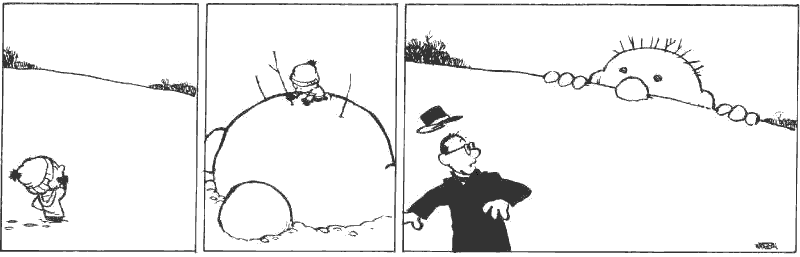
And even if Calvin & Hobbes was taken down a notch in the art department it would still provide humor because the writing and structure were solid. But that's where Calvin & Hobbes had an edge. Bill knew how to write and put it together in a structure, but he used his art to push it even further. So much that he made strips like this with no words at all.

In the end we all can't have Calvin & Hobbes like comics of our own. It's just a reality, but that doesn't mean we shouldn't try. After reading it for a few days I found myself wanting to tap into that mojo Bill had. But it doesn't take mentoring, a class, or something found in a book. And it definitely doesn't mean COPY HIS STYLE which a lot of fail-artist think when they know something is wrong with what they're doing.

It takes passion and dedication. The price of admission being the time spent drawing away in my sketch book. The endless desire to push my skills to their limits. That includes making use of the 5 shots, 3 angles, perspectives, bold-blacks, dynamic poses, and joke structure in general.

Writing is one thing, drawing is another. To put those things together in a comic strip is something completely different. That's where a lot of comics fail, but Calvin & Hobbes didn't.

Tuesday, June 19, 2012

Break it down: Dragonslayer

I wanted to start a new feature where I break down what I consider to be a well written piece of entertainment. Thanks to a 30 free trial of Amazon Prime I watched Dragonslayer, a movie that never made my embarrassingly large DVD collection, and was awestruck on how solid the story was. Even though at the time it was mostly passed off as a Special Effect movie. Oh how wrong the critics were.

So where to begin...

Lets start with the characters. It's my firm belief that a story is only as good as the characters that are charged with playing it out. We got Galen the apprentice as our protagonist. He starts off as a naive apprentice, but when his master dies he shows a lot of Extraversion characteristics. He wants to be around people, he likes being the center of attention, he wants to please others. These characteristics are what get him into trouble in the story ( more on that later )

Then there's Tryian. When he's introduced at the start of the film he gives off an antagonist vibe. He kills the Wizard, and later his servant, and shows no compassion for Galen throughout the movie. However he's not an antagonist. This is revealed later when the Princess is selected by lottery to be the sacrifice for the Dragon. The King asks Tryian to do something about it, but Tryian protests that his first duty is for the Kingdom. Tryian is Conscientiousness. His duty comes first, that duty to protect the Kingdom. The sacrifices have done that for decades.

Tryian isn't so much an antagonist, but a person who's trying to do good from his point of view which justifies all his actions, even fighting Galen at the mouth of the Dragon's Lair. The same could be said for the King. He was held by his duty, until it became personal.

Finally there's Valerian. She posses a lot of Neurotic characteristics, which could have been the result her father hid her as a boy her entire life. She doesn't trust others and looks down on herself. Even when reveals to everyone she's a woman, she still holds back socially. Unaware that Galen has feelings for her. Besides that she is also tormented. Tormented by the fact she hid her gender to keep herself out of the lottery. This inner torment lead her to find a solution to kill the Dragon. It was Valerian who convinced others to seek out a Wizard. She wanted redemption for what she had done while others went to slaughter.

There are other characters that drive the story, but with these 3 main ones the authors had enough at hand to create ups and downs that would be the driving force of the story.

The Story...

At the start we're given the premise. The King selects by lottery a virgin girl to be sacrificed to the dragon. In return the dragon doesn't burn their crops. It's a deal that satisfies both parties. The people are left in peace, and the Dragon gets treat. Especially since the dragon is of a dying race. It has no benefit to gather attention to itself and the control over that Kingdom with fear is all it needs to live out it's life. In the years though that fear turns into something the people want to do away with.

So we have Valerian and some citizens go on a journey to find a wizard to defeat the dragon. Ulrich is that wizard, but he'd probably die on the journey alone. Especially since he's already seen his death in a vision. Now we're given two Chekov's Gun, the amulet Ulrich always has and seems to be the source of his power and his vision. However their true nature as Chekov's Gun isn't reveal until the end of the story.

Tryian is introduced and asks for a test. A test that kills Ulrich. Shocked by his death, Galen later finds the amulet is speaking to him somehow. He also learns that it has given him great power. With Ulrich dead, he decides that this is a sign to finish the quest and kill the dragon himself.

On their journey Hodge, Ulrichs servant, is also killed by Tryian. He was carrying a pouch of Ulrichs ashes and tells Galen " burning water..." before he dies. This is another Chekov's Gun. It also shows that Hodge went along with Galen because he knew of Ulrich's plan, but Galen is oblivious to this. Now by himself, Galen tries to kill dragon with his new found powers.

This is where the protagonist Galen finds his first challenge. When arriving at the Kingdom the party stops at the dragons lair. Galen proceeds to create a landslide to trap the beast. He seems to have succeeded. When they get to the Kingdom the peasents have a party for Galen, he is at his highest point of popularity. Then Tryian arrives to invite Galen to see the King.

It is there the King discovers Galen is just a boy and probably a fraud. He steals the amulet and tells Galen he put the Kingdom in more danger then before. While Galen is locked up, the King was right. The dragon attacks the Kingdom thus forcing another lottery. Galen escapes, but instead of running away, he decides to right his wrongs and face the dragon. He isn't doing this for the Princess who was chosen, but because it's the right thing to do. He was inadvertently responsible for the deaths the dragon caused due to the landslide, and he is seeking redemption.

However his plan is interupted by Tryian, who again is charged with stopping Galen for the good of the Kingdom. Even the Princess knows this by voluntarily sacrificing herself to the dragon even after Galen releases her. In all, Galen is the only one who seeks hope in a hopeless situation. He kills Tryian and tries to kill the dragon, but fails again.

Now at his lowest he finally gives in and decides to leave with Valerian. He is now an outlaw for trying to save the Kingdom and no one else will stand by his side. However before they take off he has a vision. Much like the one Ulrich had in the beginning of the story. He then learns that Ulrich had a plan to kill the dragon all this time and he was too stupid to see it.

Galen and Valerian go to the burning lake in the dragons lair and spread Ulrich's ashes over it. He is now reborn. Ulrich then tell Galen to destroy the amulet, along with himself when the time is right. This is the true Climax of the story and Galen does as he's told when the dragon grabs Ulrich. The amulet is destroyed, Ulrich is destroyed, and the dragon is destroyed.

As a reward for his arrogance, Galen isn't given the credit for destroying the dragon. The Kingdom declares the King as the Dragonslayer. But that doesn't matter. Galen knows he did the right thing, and now he has Valerian with him. Knowing the Kingdom is safe is good enough for him, but at the end both characters have their mistakes corrected. Galen being cocky and Valerian hiding from the lottery all her life.

Conclusion...

Is Dragonslayer the best story ever? Far from it, but it's a great example of how different personalities play off each other. High points and low points the protagonist goes through. Mixed into a totally made up world that is not normally seen or visualize in most medias.

It's a simple story that is surrounded by all those elements that make it a unique experience. So unique that in fact Dragonslayer was a box-office bomb. It was one of those movies that became a cult classics by being aired on cable for the years to follow that also sparked the imagination of a generation. A generation that saw a revolution in movie making only to see it be destroyed years later.

To be honest, I'm one of those who think movies have been on the decline since the 90s. And most of that decline has been from the storytelling point of view. Today it seems the movie industry thinks special-effects and actors come first while screenplays are crapped out as fast as they possibly can to start production.

It's more like they've become a victim of productivity. The process for filming a movie and added special effects has been streamlined compared to 30 years ago. If a studio has a 4 month opening for a film, they'll take advantage of that and the story is what suffers.

On the flip-slide there have been quite a few gems out there that went through the same process. Scripts that were rushed that ended up being good because they stuck to the fundamental elements of what makes a story work. Dragonslayer could be an example of that, although I have no idea how long it took them to write it, but what it doesn't have is a story full of questions that has the audience wondering about things.

It has realistic characters that perform with in their abilities. It has a cascade of events that are sparked by not only the overall plot, but the characters themselves. Plus it properly displays their motives for their actions. In the end everything is wrapped up in a tight package with no loose ends.

Although even that is becoming a lost art. Today movies are made with the intention of a sequel and audiences are given tripe in the form of The Golden Compass and The Green Lateran where they were made with sequels in mind. Something I believe the Star Wars prequels suffered from since they were billed as a trilogy before they were even written, where as A New Hope wasn't given that kind of guarantee. It was implied, but if it had bombed it would've been one of those mysterious things as to what would the other chapters have been like.

Overall I feel Dragonslayer is a good measuring stick for the amateurs out there who want to tell their own stories. You can have a large world full of magic and mystery, but in the end the story has to be character driven. The events have to make sense for that story alone, with nothing added for future stories. The ending has to be a full resolution with no loose ends or what ifs.

Otherwise you'll end up biting more than you can chew. It's hard enough to tell a good story, but to plan ahead and plan out more stories in advance, that just more work and wasted energy. It's good practice to focus on the now and make sure that's good enough. Let the sales or fan base make that decision for you.  Concentrate on making the project you're currently making the best one you've ever made.

Wednesday, June 6, 2012

Writing Structures and Blue Prints

I can't believe it's been 5 months since I started getting overly obsessed with writing, and I still haven't written anything, but it was something that had to be done. I cringe at my old comics ( even the most recent ones ) and other peoples work when I know it could have been better.

To be honest I'm not a guy who just likes great stories, I like stories that at the very least make sense. Something I find " professional " writers, producers, and directors mess up just as much as amateurs. It doesn't have to be that way. The steps to insure that are as simple as taking ones time, having a plan, and sticking to it.

Personally I love reading bad comics, watching bad shows, and bad movies. I learn what not to do. The good part about that is the more I know what not to do, almost everything left over is what to do. And it doesn't require a critique from a " professional " to realize this. Every person, no matter what their knowledge is on art and writing, is an honest critique. The trick as a creator is to make sure the limit of what not to do's is at a minimum.

Future posts of this will include character creation and art in general, but since I consider writing the most important part of any sequential art I'll be concentrating on that in this post. So let's begin...

Story Structure and Page Planning


I had the fortunate event of my cable being out for 8 hours the other day so I decided to read some more how to books. One thing I've known about is page planning. It is crucial that any comicker out there has their pages planned out ahead. I'm not talking about thumbnails, that comes later. I'm talking about what scene goes to which pages and so forth.

I touched on it here http://one-shotstructure.blogspot.com/2012/02/24-page-plot-first-story-structure.html but even when I made that one, I knew it wasn't going to be final. Just as I discovered when I was trying a new art style, my writing style will take time, experimentation, and refinement to suit my needs. While that story structure will work, it didn't seem to work for me. So I made another one...

This one was geared for Action-Packed stories. Each Act has it's own little problem, solution, and climax with the final act being nothing but climax to finish it off. I got this Story Structure from my old GI Joe comics written by a real American hero Larry Hama. Most of those comics follow this type of structure where events escalate to their boiling point in Act 3 and works great for a comic where two sides are always in conflict. I thought this would be for me, but it didn't feel right. So I made another...


This Story Structure was ripped from Kolchak: The Nightstalker ( which not coincidentally is the same structure for the X-Files ). I thought a mystery structure would fit me more, and while I was piecing it together it did feel that way. However just like the Action-Packed one, it still didn't feel right. While this is more character driven than the previous one, it still didn't fit the characters and settings I'm currently working on. I needed something less mysterious, and more humorous to fit the idea I have. So I made another one...


The Two Story Structure was based off of tv shows. Basically American Dad, South Park, and How I Met Your Mother or any show where two stories intertwine and may or may not meet up in the Climax. At this point this one feels like it fits my characters and settings ( for now, lol ). I won't rule out I'll go back to the drawing board and make another. Unlike the previous two, this one is way more character driven, where the characters personalities, habits, and desires push the story. That's what I'm going for, so I'll see how it works.

Now all of these structures took a lot of time for me to make. It wasn't an excuse, it was a necessity. I've learned my own past mistakes that I need a plan in place before I even have an idea. I need to know where everything has to go and how it all works together before I thumbnail the first page. This information is usually buried in How To Books. In How To Draw Manga Vol 1 it's buried early on in the book. In Will Eisners Sequential Art it's in the back and written with a bunch of large words ( I always have to have my Websters Dictionary handy to figure out what he was talking about ).

However my experience as a CNC machinist has taught me I relate better when visuals are added rather than numbers and words alone. Which coincidentally is what a comic book is. Visuals, words, and numbers. The visuals are the images in the panel, the words are the dialogue and captions, and the numbers are the pages. That's why I drew out these structures after piecing them together in a notebook.

Why this is important


In the past I always did things off impulse with no plan in place. I may or may not finish a comic, and when I did it was rushed the closer I got to the end. I wanted that to stop and these structures prevent that from happening. They are the blue print for making a 24 page comic that makes sense. It doesn't matter what the content or plot is, it's about the math. It's about having every page reserved for a specific scene and having them all add up in a perfect package.

I've been around the block, I know when people rush their stories/comics and phone in the last few pages. They had no plan in place, and it shows. I'm more susceptible to this because I've been there. I've seen first hand what a lack of planning looks and reads like because I've done it myself. And this type of planning isn't restricted to comics. Animators have a plan in place called the X-Sheet, where every animation is planned out ahead of time.

A proper plan insures proper execution and every artist/writer needs to have this in place. Take my machining background for instance. If I was told to make a part with just handwritten instructions and spec numbers, I'd fail at making that part a good number of times before I get it right. With an image of what it is suppose to look like I have a better idea of what I'm working with. The instructions make more sense, the numbers add up.

The same goes for comics. As a writer/artist one has to know how much room they have to work with. Scenes have to be limited so they don't run out of control. And pagination is important if that person wants to print their book ( notice how the Two Story ends up being 32 pages total )

Conclusion


I'll probably never stop making these structures. They give me insight on the entertain I like, the stuff I want to emulate into comic book form. However when I made the Two Story Structure it felt like I was really making a comic book. That was the 2nd draft of it, I added the inserts in between the Acts to act as buffers ( i.e. commercial breaks ) where a scene is interrupted by a Cliffhanger only to be continued a couple pages later. Like the comic books I grew up with and still read.

When I was drawing it up I imagined my characters playing out certain scenes. Their discoveries and interactions while the structure was progressing. That was something that wasn't present in the other structures I made.

In the future I plan to dwell further into other things I've learned this past year. And what a year it's been. I went from making comics that took the Protagonist from point A to point B that barely made up 16 pages to constructively planning out 24 pages with twists, turns, and cliffhangers. In return my artwork has improved from being " I dunno if I can do that " to " no problem, we'll bang okay ".

A famous beta-artist once said you can't force improvement for improvement sake, improvement has to be natural. That's bullshit. Last fall when I was at my lowest I wanted to improve. I knew it wouldn't take overnight, it would take time. And I can say with confidence that it was all worth it.

The breaking down of story structures, proper character creation, working in a style that works for me, the 6+ hour sketchbooks sessions, the constant practicing of compositions, and format experiments have paid off. Sure it's not a monetary payoff, but some things in life don't need money to justify their existence.

I may never make a dollar off my stuff, it's a reality I've already accepted because after nearly 20 years I have yet to make a dime off anything I made. But that's not why I do this, that isn't why I push myself. It's because I love comics. I'm obsessed with them. And I want to make them the best way possible to at least satisfy me.

Money is one thing, but that feeling I get when I look at my past work and I'm surprised I actually made that. There's no price for that feeling, it's addictive, and I want more of it.

Sunday, April 1, 2012

American Dad Break-Down

I've complained about how hard writing is for me before. Apparently I've become so cynical over the past few years that not only do I find my own stories boring, predictable, and illogical I also find most entertainment the same. I'll be honest, I watch a hand full of shows. My two favorites being American Dad and How I Met Your Mother. There are a few others, but those two shows share the same kind of story structure. It wasn't until I went through a marathon of both shows I realized it.

In my last post I created an early blue-print for a story structure I wanted to use for a 24 page comic book. I was already on the right path, but something was missing. It wasn't until I dug deep into my obsession of American Dad and How I Met Your Mother that I realized what was missing. Chekhov's Gun.

Both shows use this technique a lot. They also use its opposite, The Red Herring. Either way they introduce Chekhov's Gun in the first act of each show. And each show is broken into at least 3 acts, in some cases both shows will also have an A and B story with different characters, but not always. At each shows core is 3 acts, and that's what I'll stick with.

Chekhov's Gun is there for the writers to make sense of the Climax in each show. In American Dad's case I'll use this weeks episode. Roger's formula for X-tacy ( spelling? ), which Stan took, and gave to Roger in the past which got Francine to hook up with the guy who may or may not be Haley's father. ( confusing I know )

That wasn't the only one. Another Chekhov's Gun was when Roger told Steve how they take your Kidney out, which was acted out later at the end of the episode. American Dad does this a lot, and it isn't just in one episode. They reference old episodes more so than other shows. Archer is another that uses this technique a lot and the before mentioned How I Met Your Mother.

Now it seems like a cheap trick on the surface, but for a guy who only watches about 5 shows in total I had to wonder why I was enjoying them. Chekhov's Gun was one of the reasons. I like how stories have that completeness to them and force you to remember events that happened in the first act. Even drama's do this, such as Doctor Who...well that's about the only drama I watch now, but it isn't really a drama. It's just awesome.

This became an eye-opener for me. Especially since I'm really depressed because I can draw like a mad-man yet when it comes to writing the well is dry. I'd figure at this time I'd have my stories, I'd have something finished, but that little voice in the back in my head is always present saying " Not yet, you'll know when it's time ".

That's just who I am. I don't want to half-ass anything I do. I want whatever I make to be something I will enjoy, not something I shitted out so I could make a quick buck. The best way for me to get there is to look at myself, see what I enjoy, why I enjoy it, and emulate that into my work.

When most people do that, they usually end up copying what they like, but with a twist. In my case, I don't want to make something just like American Dad. I want to make something that utilizes Chekhov's Gun like American Dad.

By realizing this maybe writing won't be so hard for me and maybe my future-self won't be as cynical on my own material as I am now.

( see, I kind of used Chekhov's Gun right there, well maybe not, but it's practice )